



Revolutionizing Tumor Response Evaluation with Exponential Tumor Growth Kinetic (eTGK) Models
Have you ever wondered if there’s a more dynamic and accurate way to assess the efficacy of solid tumor treatments? What if you could predict the day when a patient’s tumor will double in size or shrink by half? Or quantitate which of these paths tumors are on during “Stable Disease”. How can we ensure that clinically relevant tumor response information is not lost in the evaluation process? These questions highlight the limitations of traditional response evaluation criteria, such as Response Evaluation Criteria In Solid Tumors 1.1 (RECIST 1.1), which place tumor responses into rigid categories rather than capturing each subject’s unique treatment path.
Introducing eTGK Models
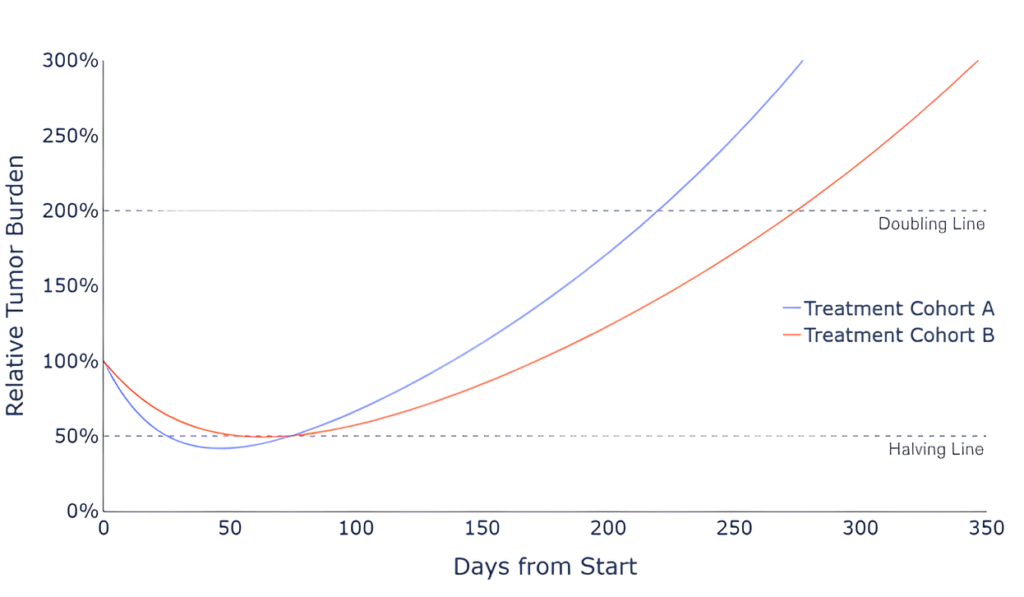
Exponential Tumor Growth Kinetic (eTGK) models offer a revolutionary approach to tumor response evaluation by representing tumor burden as a continuous function over time. Each patient is fit to their own eTGK model based on estimates of their tumor burden at each timepoint. These models can be mathematically extrapolated based on known principles to determine and/or predict patient doubling and halving times, enabling the comparison of not only growth and decay constants across patients, but also when patient tumor burdens are expected to shrink or grow beyond a determined threshold.
Additionally, these growth and decay constants can be averaged across treatment cohorts to generalize how groups are responding to treatment. In the figure above we notice that although the average patient in Treatment Cohort B is estimated to achieve halving time approximately 30 days later than the average patient of Treatment Cohort A, the average patient’s tumor burden in Treatment Cohort B doubles in size almost 50 days later. This implies that although Treatment A may be initially more effective, Treatment B displays better long-term suppression of cancerous growth.
Dr. Manish Sharma, CSO at Imaging Endpoints and a leading researcher in the field, notes: “While RECIST remains the gold standard for regulatory robustness, eTGK models are of increasing interest among regulators and offer unparalleled insights for exploration and earlier efficacy decisions, enabling a deeper understanding of tumor dynamics that are not possible with any other criteria.”
Key Advantages of eTGK Modeling
- Identify Predictors of Overall Survival (OS): eTGK models have been used to identify strong predictors of OS; a metric crucial to improving patient outcomes.
- Identifying Best Responders to Treatment: eTGK models can be used to identify the best responders to treatment, potentially helping sponsors identify the most effective treatments and the most receptive populations.
- More Inclusive Assessment of Tumor Burden: Kinetic models can be fit using any measurement of tumor burden including: volumetric assessments, long axis measurements, and biomarkers.
- Proven Success Across Tumor Types: eTGK models generalize across thousands of datasets from various tumor types. In a study of 17,140 patients, of the 8 models used, the exponential model was the best performing fit for 86% of patients.
- Time Based Representation / Evaluation of SD: Kinetic models treat tumor burden as a continuous function, allowing clinicians, researchers, and doctors to visualize the trajectory of patient tumor burden between timepoints. This includes far better insights for evaluating responders vs non-responders during the Stable Disease (SD) categorization.
- Predictive Tool: eTGK models can be used as a predictive tool to forecast future tumor growth and shrinkage.
- Early Prediction of Study Outcome: eTGK evaluation, as deployed by Imaging Endpoints, may predict trial outcomes from just 20% of patients achieving 3 or more timepoints.
Imaging Endpoints (IE): Your Partner in Innovation
IE brings unparalleled expertise in the independent analysis of radiological data and images, collaborating with scientists, oncologists, and radiologists to optimize imaging criteria and incorporate cutting-edge methodologies in clinical trials. With a proven track record of improving trial success rates through meticulous study design, we offer comprehensive data analysis, including the development and application of eTGK models. Our team provides valuable support in interpreting and analyzing these models, advising trial sponsors on their applicability, and offering statistical analysis for different treatment groups. Partner with IE to harness the power of eTGK models and our extensive range of services to advance your clinical trials. Together, we can drive innovation and improve patient outcomes in the fight against cancer.
For more information,


